Connecting People in the media

Earlier this week, Martin our principle investigator was informed that a short article that he had written recently was now up on the Mental Health Care website. The article gives a concise introduction to the workings of the Connecting People model, as well as touching on the social capital theory that lies behind it.

The Mental Health Care website provides reliable information for the friends and family of people with psychosis – aiming to be a source that avoids some of the inaccurate and stigmatising information that the internet can be riddled with.

You can read and download the article here

Our article has been placed as a download in the ‘recovery’ section, where we feel that it fits perfectly.  We are lucky that it has been one of the top downloads this week from the site.  It is great to see that the families and friends of individuals with psychosis – a group of people that can be so key to the success of the Connecting People Intervention – are clearly interested in what we are doing.

We hope that you will be seeing a lot more about the study across various websites and forms of media.  Indeed, if you have an idea of a website, initiative, or social media platform that you believe we could be taking advantage of to further publicise our work, please do get in touch by contacting us.


Mapping Community Assets Training Activity

Fundamental to the intervention is the use of local community resources to help individuals to become more integrated into mainstream activities; meeting others from within and outside mental health services.  It is necessary for workers to share their knowledge of community resources to help this process be as efficient and useful as possible.

Many of the skilled workers engaged in the Connecting People Intervention Study have their own bank of local knowledge.  When asked where information about the local opportunities for social participation is captured, we heard of physical files, computer drives, or more commonly described by one worker who simply pointed to her head!  It is true, agency teams hold a dearth of knowledge in each worker, some of whom are “experts” in various domains of the community such as sport groups or religious associations.  But collectively across the team, greater knowledge of the community (local or community of interest) can reduce workload over time.

Therefore, we have found one useful training activity for agency teams has been the identification and mapping of community assets.  The session aims to look at how relationships with the wider community can be developed for both workers and individuals.

Typically the session begins as a group discussion (or small groups by local teams) to define “community asset” and provide examples based on current case loads.  We ask workers to each write five community assets on small slips of paper.

Mapping community assets

We then ask workers to share their five assets with the other team members, and in the centre of the room work together to somehow group the assets.  For example, in one training session workers grouped assets into the following domains:

  • Religious and Cultural Groups
  • Education
  • Arts and Crafts
  • Sport
  • Alternative Therapies
  • Non-Commissioned Services
  • Neighbourhood Activities/Associations/Events
  • Horticulture
  • Volunteering
  • Other: LGBT, Women’s groups, etc

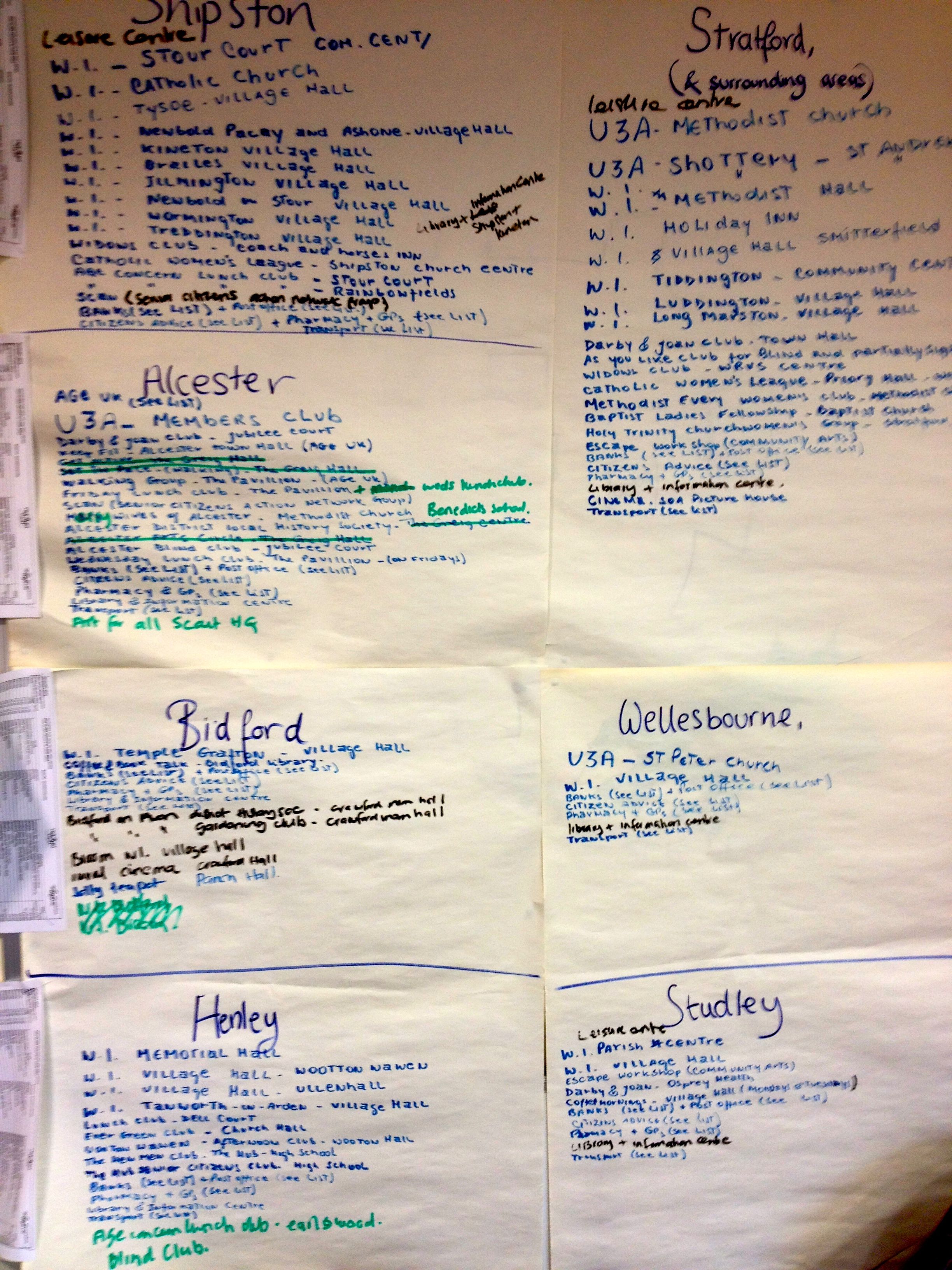
In another training session, workers identified all the services and assets within specific geographical areas.

Community mapping by area

Once the arrangement has been established, workers are encouraged to add assets from their own knowledge of the local community.  By the end of the session a small map of the community assets has been created.  Some questions to consider of the group: What might be the connections between these assets?  Where do the workers and individuals fall within this map?  What assets might service users bring that workers are unaware of, how can they become involved in the mapping process?

Lastly we encourage the team to develop Action Plans through discussion of how community mapping can move forward, be regularly used and updated, and become a shared resource within the agency.  Feedback from workers has been positive and we can already see that agencies are taking this on as an opportunity to create resource directories and as a dynamic way of sharing local knowledge.

Overcoming Barriers Training Activity

One of the most recent training exercises that we have designed involved looking at new ways of overcoming barriers.  Quite a lot of the other exercises that we have tailored to this section of the model have focussed on the power of the group for inspiration – for example presenting a difficult case to the other members of the training group and asking them for positive suggestions on how to overcome these barriers.

For this exercise, though, we wanted workers to find their own solutions to the barriers that they were facing.  In small groups of around 3 or 4, we asked them to identify the biggest barriers that they themselves faced that would stop them from implementing the Connecting People Intervention as they would otherwise want to.  We also asked them what they thought the biggest barrier facing the individuals that they worked with was, which would stop them from moving on.

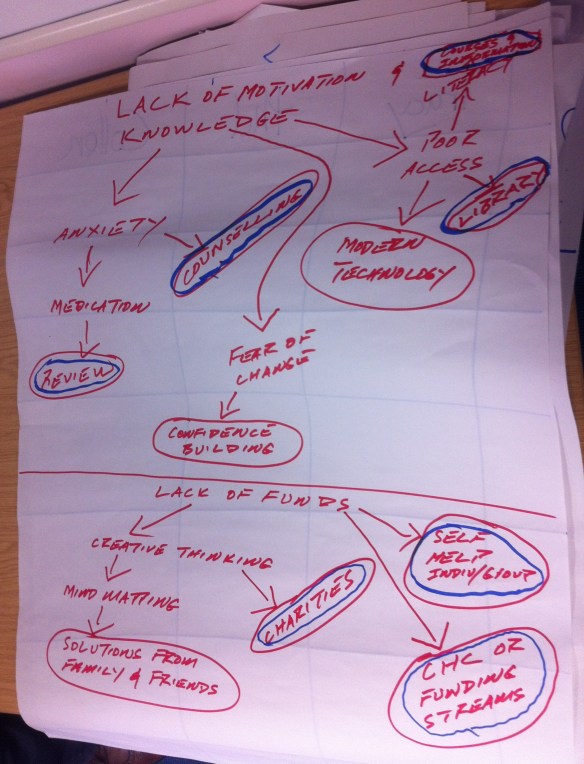
These barriers tended to be quite overarching concepts – for example ‘lack of funds’ for the worker or ‘lack of motivation’ for the individual.   They were seen as large, somewhat insurmountable barriers due to their abstract nature and therefore difficulty in dealing with.

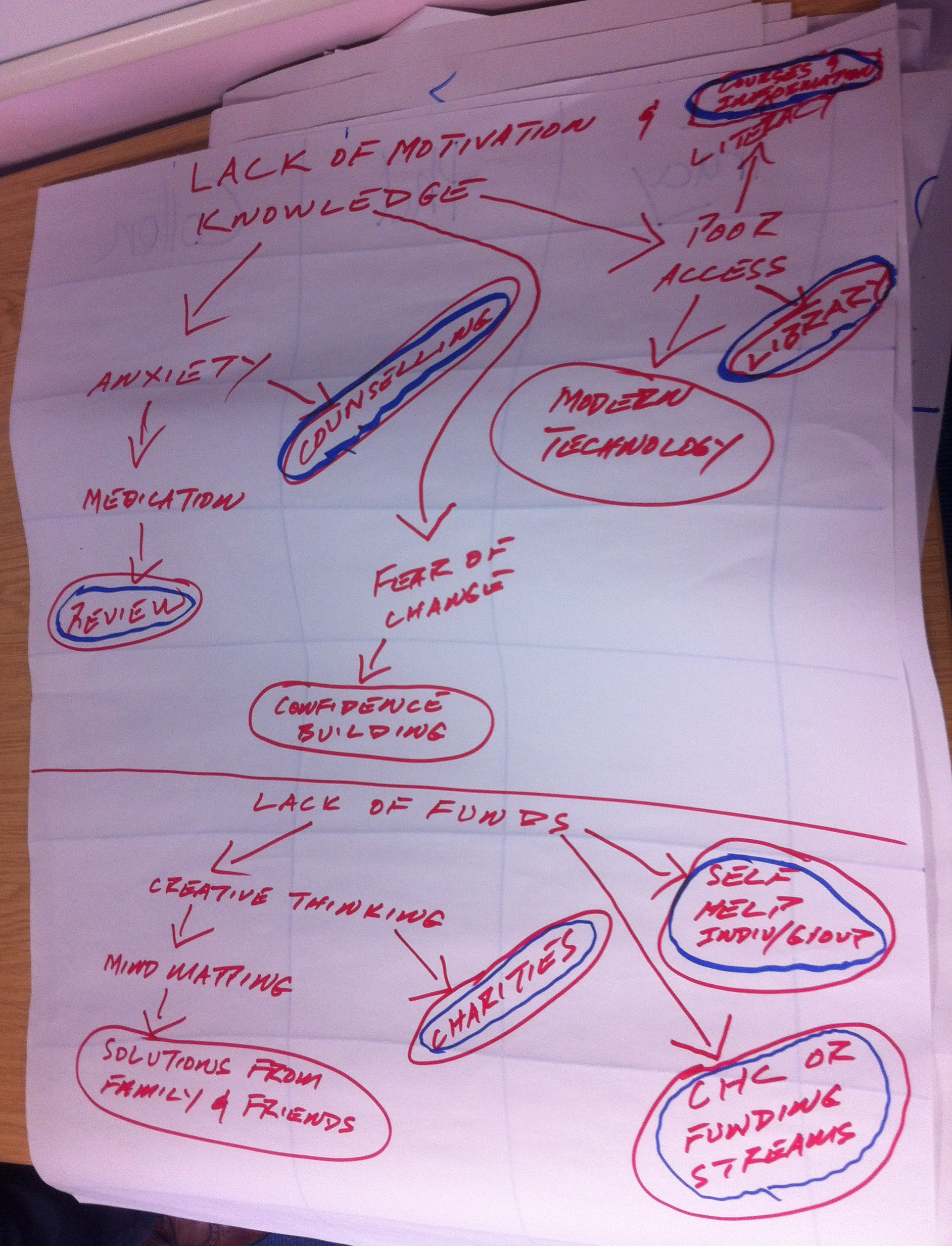
The workers were then asked to take each of the barriers identified, and on large pieces of paper split them into their component parts to form a spider diagram.  The barriers continued to be broken down until they reached a collection of singular, discrete problems.  Once workers had got to this stage, they were asked to think creatively about a solution – imagining that apart from this one issue, there were no other barriers faced.
Mapping Agency Barriers

The first time that we conducted this exercise we had expected the solutions that they came up with to be quite fantastical given this freedom, however we were pleasantly surprised that the workers tended to give very practical solutions that were perhaps just slightly outside of something that they would have done in every day practice.

When workers had come up with a solution, we asked them to circle it so we could see where it was on the page, and then carry on thinking up solutions for each of the discrete problems.

Once this had been accomplished, the groups were instructed to look again at each of the solutions, now in the cold light of reality and with the other barriers that were faced back in play.  They then circled the solutions that could still be achieved in a different colour.

Most were surprised to see that in fact, the majority of their solutions were realistic in the present, and could be achieved.  We created a quick chart to show the major barrier and the small component solutions that could be implemented to at least partially overcome it.  This was incorporated as part of the training material given to the group after the session, to enable them to work more effectively with the intervention.  Workers feedback suggested that this approach was a useful one, and that they would not only be repeating this process on other barriers, but also would refer back to the list for practical solutions should they face one of those that they had examined during that training session.

Training Activities

We are in the midst of training 15 agencies in the Connecting People Intervention for the Pilot Study.  The agencies are diverse, ranging from small third sector social enterprises to large NHS Mental Health Trusts.  Yet across all sites there has been a unifying message that the model accurately reflects current practice and equally illuminates both the areas where workers excel in enhancing social participation with individuals and the current challenges that are faced by health and social care workers.

We have found that each agency team is unique in their approach to working within the model and therefore our training sessions have been greatly adapted to fit the strengths and needs of each agency.  Similarly to the development of the model itself, the training sessions have been co-produced between the research and agency teams in an effort to maximise the model’s utility for individual workers.

Over the coming weeks we will be sharing some of the training activities we found particularly beneficial.  We hope that by sharing our experience the agencies involved in the pilot study will be better equipped to use the activities when training new staff and take the intervention forward throughout the duration of the study (and beyond!).

Maximising Research Impact

Martin, Hannah, and Meredith recently attended a Research Impact workshop, hosted by the Social Services Research Group (SSRG) to address the gap between research, policy and practice that exists in health and social care research.  The SSRG is a non-profit organisation which aims to provide a network and forum for research with members coming from a range of professional groups and organisations committed to advancing knowledge of social and health care services.

The Research Impact workshop focussed not only on the translation of research but also on the localisation of results into relevant contexts.  The day offered an opportunity to discuss some of the barriers to dissemination and implementation of research results such as language, length, and complexity of research reports.  Diversity in social care services was mentioned several times throughout the day as the field is challenged by many different stakeholders and a varied extent to which practice can be evidence-informed.  Solutions were discussed to engage practitioners with new media, research training opportunities for qualifying practitioners, and developing a formal network to connect with independent sector organisations.

Martin joined Chris Rainey (West Sussex CC and SSRG) and Deborah Rutter (SCIE) on a panel at the start of the day, and we all enjoyed the opportunity to network with other professionals in health and social care.   As a team we discussed ways that we can reach a wider audience with the results from the Connecting People Intervention Study.  Some of those include brochures to share our results from the systematic reviews, videos and packages of training materials, and of course continuing to promote the blog for frequent study updates.  We welcome your feedback on useful tools to disseminate our research findings, please feel free to leave comments below!

What others think

For the final update, we decided to take a look at what workers who have recently been trained in the model thought of the intervention.  Martin spoke recently to Griff Jones, Social Care Lead and Approved Mental Health Professional in Derby City Council, about this recently.  He writes about this here.  You can read the full article and many more relevant posts on Martin’s blog – take a look!

“One of the aims of the Connecting People Study is to help articulate aspects of mental health social work practice which have been largely undefined.

For too long social workers in mental health settings have found it difficult to articulate the unique contribution they make beyond their statutory functions. The Social Perspectives Network, amongst others, have helped to make the case for social work, but there remains a lack of high quality research evidence on the effectiveness of mental health social work.

The Connecting People Study provides an intervention framework which is amenable to rigorous evaluation. It resonates with mental health social workers and early feedback from practitioners suggests that it helps to define their role in connecting people with others to assist their recovery.

Griff Jones chose to participate in the pilot study to help social workers articulate and evidence their role in mental health teams. He told me:

“In choosing to participate in the study, I felt that it dovetailed very well with the move towards self directed support and would help social care colleagues to be able to use a model which would guide and inform their practice. I was particularly attracted to the partnership approach to work with clients as this also linked into the recovery model in mental health.

I feel that the intervention helps to enable social workers to identify what they are able to offer in the field of mental health, particularly in relation to developing and enhancing individuals circles of support and looking to link in with community resources.

The staff who attended the training have responded very favourably to the intervention, in particular as it has helped them to reflect on what their role is as social care staff working in Mental Health Services.

At present within Derby there is a review of what social workers do in mental health services as the local authority seeks to ensure that our practice is more reflective of their objectives rather than being, in the main, just meeting Trust objectives. The intervention will hopefully be used to help inform this review so that any future service model is based on core social work values”.

We are hopeful that the study will help social workers to articulate their role and provide evidence about its outcomes so that reviews and service reconfigurations can be more evidence-based than they appear to be at present”.

That’s it for our updates.  We hope that you have found it useful to read them, and get to know how we are getting along with the study.  If you have any further questions on any of these posts, please get in touch by emailing hannah.reidy@kcl.ac.uk

Looking forward to hearing from you!

Systematic review

Today, Meredith tells us about her work with Sharon on the systematic reviews:

“Sharon and Meredith have been busy over the summer completing three related systematic reviews.  The purpose of these reviews was to identify research focussed on health and social care interventions that promote the enhancement of social networks for 1) adults and 2) older adults with mental health needs, and 3) adults with a learning disability. 

 With only 26 studies across the three reviews meeting inclusion criteria, the small sample limits the overall findings of effectiveness.  The diverse studies that were identified provide evidence for the use health and social care interventions across a range of mental health needs.  Additionally, several key features were found across numerous successful interventions that are also components in the Connecting People Intervention (CPI) Model: strengths- and asset-based approaches such as goal setting, problem-solving techniques, social skill development; an aim to enhance the worker/service user relationship; and engagement in activities for which participants had an existing interest.  Whilst results from the small sample should be considered with caution, we also consider these key features integral aspects of the CPI model.  

The findings from these reviews underline the assertion that future interventions are needed to enhance social network development in vulnerable adults with mental health needs.   The three reviews offer the most comprehensive assessment of the evidence of interventions aimed to enhance social participation and wellbeing in mental health populations to date. There is a clear gap in evidence for effective health and social care interventions, and the few studies that are available reflect the disparate nature of research in this field.

 We are currently in the process of submitting the reviews for publication and will keep you updated on the progress in coming months.  If you’re not currently subscribed to the blog, please enter your email address on the right side of the Home page and we will be sure to let you know when the reviews have been published”

Technology and the intervention

For today’s blog post, Ian talks about how the work he has done with the Connecting People team has created a sleeker, more engaging set of materials.

“The team have been and continue to be involved with the training of agencies across the country in how to implement the Connecting People model.

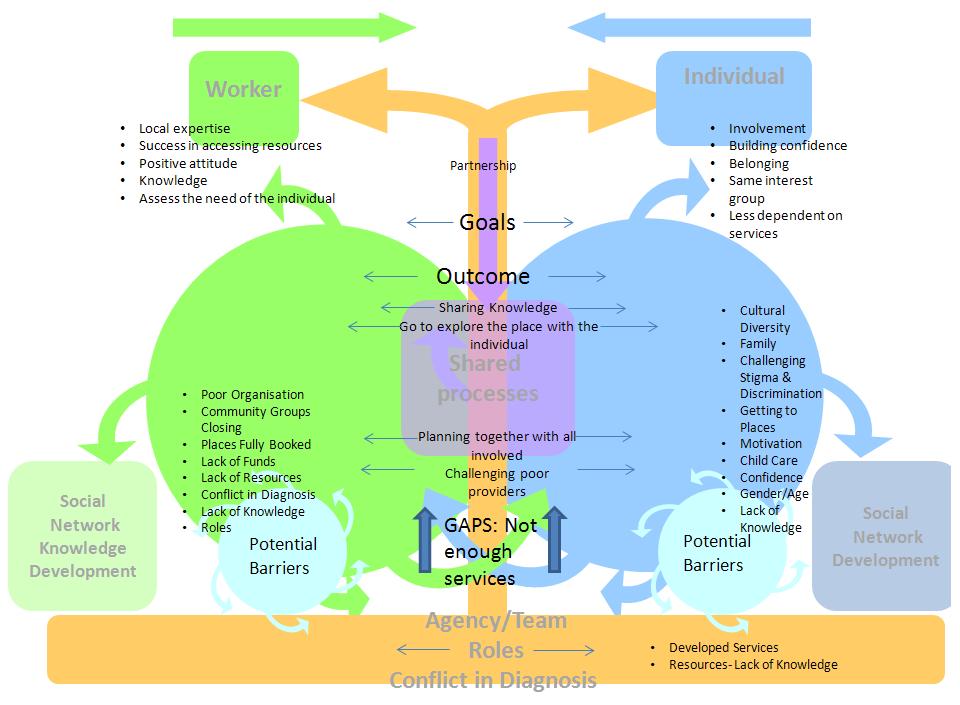
To aid this process we have created a PowerPoint presentation to be delivered at these sessions. The presentation incorporates a narration by the Connecting People team and animated sequences which help to communicate the different elements involved in the model. 

We have recently held a meeting with an advisory group which highlighted areas in which this could be improved. The comments of the advisory group were appreciated and the team are currently looking at ways to incorporate these improvements into the presentation. 

You can view a draft version of the model here: Connecting People Presentation V4 Please note that this is only a draft and has yet to be finalised and approved.

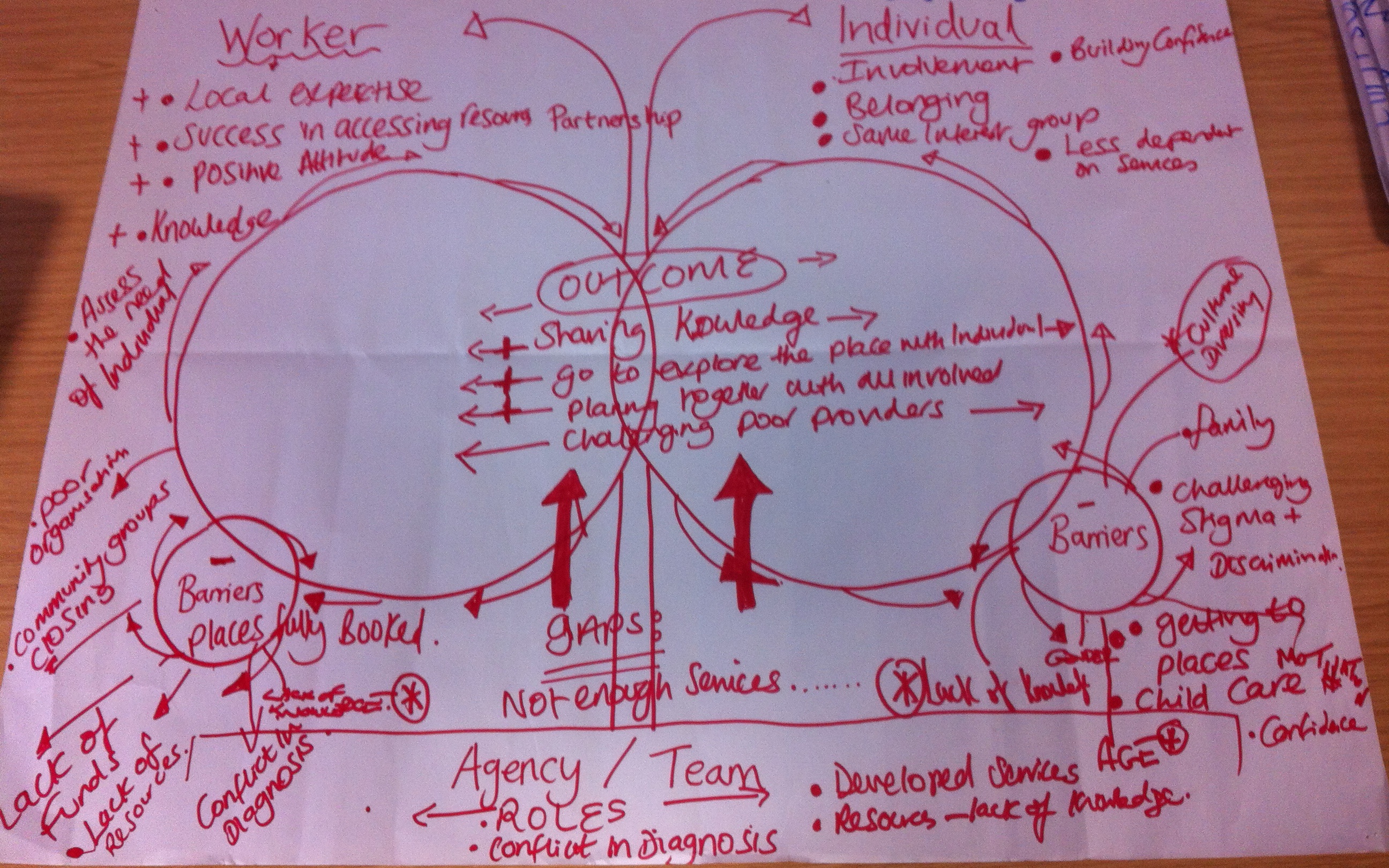
In addition to this, as part of the agency training sessions we ask them to create their own version of the model that applies to their organisation. 

Before…

This is done on flip chart paper to encourage constant amending and editing during the course of the training.  After the training, these rough drafts of models are taken and fitted to the powerpoint slide depicting the model, providing each agency with a bespoke version of the intervention that they can really work with. 

These are just a couple of the ways in which we are using IT and technology to work better with the intervention”.

…and after!

Designing the information for individuals leaflets

Today, Hannah talks a little about one of the other aspects of our work – designing the leaflets that give information to individuals participating in the study.

Advisory group in progress on the Isle of Wight

“When an individual attending an agency or organisation is asked if they would like to take part in the ‘connecting people study’, they will probably not know exactly what this will entail.  To help with this situation, we have been creating a leaflet that gives straight-forward, practical information to these individuals about what they can expect from the intervention and what they will need to do.

We are very aware that the different client groups who will be working through the intervention have very different requirements from this leaflet.  To make sure that we create material that is directly relevant to them, we decided to hold advisory groups with representatives from each client group.  The first of these was in Somerset, where we worked with several individuals who had suffered with mental health problems.  Their feedback on what they would need to know, and how they would want the leaflet structured provided us with a solid knowledge base to start working from.  We created a double sided, a4 leaflet with quotes from individuals who were already a part of the Connecting People Intervention, and clearly written sections about what to expect.  Following their advice, we made the leaflet bright, clean and colourful, and included photos of individuals from agencies working with the intervention.

We took this leaflet to our next advisory group, a group of around 25 individuals on the Isle of Wight who have learning disabilities.  This group wanted a completely different format – rather than a leaflet they wanted a step-by-step ‘map’ of the intervention process.  We used their ideas to create a pictorial map of what to expect.  We then used the comments that they gave about what was most salient to know about the intervention to create a more text-based guide on the reverse of the map.  This is aimed at the worker, to use as a script and run through with the individual to ensure that they understand.

Researchers and participants at the end of the advisory group

These two groups of people have helped us to create truly tailored information sheets for the individuals who will benefit from the intervention – and given us ideas that we would not have considered ourselves.  We are looking forward very much to the advisory group with older adults living with mental health problems, and are intrigued to know how different their suggestions are from the others”

First interviews…

Today, Sharon – one of the researchers on the pilot study – tells us a little about her recent work within the Connecting People team.

Recently, the Systematic Reviews have been written up in draft format, and for the Learning Disabilities population group, we are now shortlisting potential journals we can publish in which is very exciting!

The first of the interviews commenced last month very successfully, four interviews were conducted throughout one day and we would like to thank the agency who recruited participants and aided with the organisation of these first interviews. It was great to complete the first of many interviews, and each participant provided a rich experience for me as an interviewer.

The interviews take around one hour to complete; some of the areas covered in the structured interview are personal contacts, housing and accommodation, education, health. Our target is to carry out these baseline interviews between now and early 2013; and after 12 months, carry out follow-up interviews with the same participants. This will enable us to evaluate the connecting people intervention. We hope to start receiving more and more referrals for participants for the study, and the new information leaflets should help with this.”