Manual-Making-Mania

After a week off holidaying, I have returned to the office to put the finishing touches on the draft of our practice guidance.  The study’s advisory committee are now commenting on the initial draft and I am currently implementing any changes that they have suggested for improvements.  In the next couple of weeks, we will send it out far and wide for comments in a consultation process, and refine it further according to what the people included at this stage think.

The practice guidance is essentially a manual which acts a as a reference guide for workers using the intervention.  It explains each part of the process, and gives gold standard approaches as well as lots of case studies from the research that has been completed to bring the guide to life.  The manual is colourful and contains photographs and extracts from websites from some of the participating agencies – all of this endeavouring to make it as easy-to-use, and attractive-to-use, as possible.  Alongside the practice guidance, training is being developed.  The practice guidance gives the ‘what things are’ of the intervention, and the training the ‘how things are done’ to fit with it.

We aim to gain as many different perspectives as possible during the intervention consultation process in order to ensure that the feedback we receive is full and comprehensive.  We are therefore going to be consulting a wide range of people: service users, volunteers, workers, management, associated agencies, advisory agencies, experts in the field of social capital, commissioners….the list goes on!  If you would like to be involved in the consultation process, then we would like to hear from you.  Your viewpoint will be unique and therefore of interest to us!  Email me on hannah.reidy@kcl.ac.uk for more information.

Kingston Recovery Alliance

Over the last few weeks I have had the pleasure of spending some time with the individuals behind Kingston RISE, a new initiative set up in and around the Kingston area.

Kingston RISE was founded and developed by individuals in recovery, and aims to create a recovery community within the Kingston area where people can support one another to continue on their journeys through life. They run drop-in coffee sessions, walking groups, and many other activities that provide support for those who need it using a highly trained team of volunteers. On top of this, they actively link these individuals with other projects within the community. They say that as long as someone is clean and sober that day, they will never, ever be turned away from their service.

We first heard about Kingston RISE through Hestia – a local housing association that we had completed some fieldwork with at an earlier stage of the Connecting People study. Hestia told us about this new, exciting team of volunteers who were pushing Kingston RISE out into the community and gathering speed and support as every week went by. They also spoke about the support that they had lent to Kingston RISE in terms of training, contacts and business support. On speaking to individuals from Hestia, it is clear that they really believe in the ethos of Kingston RISE and are willing to go above and beyond to try to ensure that it is a success.

Another group that are in favour of Kingston RISE are the commissioners. They have aided Kingston RISE to grow and innovate without placing too many restrictions on the process, and have developed an excellent rapport with the individuals running the service. This friendliness allows for debate and discussion, rather than the banker-client relationship seen between so many councils and the projects that need funding. There is no feeling of anxiety before a meeting with the commissioner for Kingston RISE, which runs in sharp contrast to some other organisations that we have visited over the course of the project. The position that this relationship has put Kingston RISE in shows the crucial nature of the environment outside of the agency, as well as the agency itself in completing good work and helping individuals accessing the service.

Kingston RISE is all about co-production. They have trained themselves up with the help of Hestia and its resources, are working closely with the Environment Centre in Kingston, and have made links with many other local agencies, initiatives and organisations to fully involve themselves with the community. The philosophy of Kingston RISE is to always ask, and to see the possibilities in a situation that can make things better for both sides of the partnership. This allows them to move forward quickly, and keep things fresh and exciting.

The team of volunteer staff that are developing the project are also key. A good sense of humour is crucial, and jokes and banter flow freely between team members. The nature of their interactions instantly puts others entering their presence at ease – no mean feat for a service dealing with individuals suffering from high anxiety levels. There is no hierarchy in the team other than in title, and this rings true with the concept of developing a recovery community, rather than a specific organisation with boundaries. Volunteers have been comprehensively trained in a very dynamic fashion – comments (and the usual banter!) flowed freely throughout the session that I observed – and the outputs of these training sessions have formed the basis for a practical, user-friendly set of policies and procedures that really echo the way that Kingston RISE will run, rather than being a barrier to them moving forward.

These individuals were so outgoing, innovative and insightful that we invited them along to help us develop a new game – the ClearFear game – last week, which aims to relieve social anxiety. Details of our Game Camp can be read here but to whet your appetite, think hide and seek, superheroes and conquering nemeses and you are starting to get a picture of the two days at the camp…! Kingston RISE were – as is typical of them – upbeat and creative throughout, challenging the rules of the game and bringing even more laughter to the group.

There is a long road ahead for Kingston RISE, who are only now at the stage of putting on a full timetable of activities and running a complete service. However if the ethos stays the same, and they continue to win the backing of organisations in the area, then I am sure that they will succeed and grow even more.

From Community Care…

Published by Community Care on 6th March 2012:

Care services minister Paul Burstow has stated that social work will be at the heart of the forthcoming adult care White Paper. He wants social workers to move away from care management to community development roles, connecting people with resources within their communities. Probably without knowing it, he was articulating the vision behind the Connecting People study.

Connecting with other people is one of the ‘five ways to well-being‘. Many people with mental health problems have small social networks and experience difficulties in making positive social connections. But there are no evidence-based interventions for social workers to use which are effective in helping people with mental health problems to connect with others.

Funded by the National Institute for Health Research School for Social Care Research, the Connecting People study is investigating how health and social care workers can most effectively help young people recovering from an episode of psychosis to connect with others.

Over the past 18 months, we have used ethnographic methods to explore practice in six agencies in the voluntary and statutory sectors. Based on field observations, interviews, focus groups and numerous informal discussions, we have developed an intervention model to guide practitioners in supporting people to develop their social networks.

The model is based upon the principles of co-production. Rather than a traditional model of workers ‘doing’ and individuals ‘receiving’, workers and individuals co-create the objectives and actions within the model together. The model represents a shared journey of discovery with inputs being invested and outcomes being produced for both the worker and the individual.

There is growing interest in co-production and social workers working with adults may be interested to learn more about it. The Social Care Institute for Excellence’s research briefing on co-production is worth a read. Publications from Nesta and the New Economics Foundation also provide valuable insights into how co-production can be applied to public services.

Co-producing interventions can be a challenge when people are in crisis, but our observations have found that this approach can effectively support an individual’s recovery from a health or social problem. Where workers have focused on an individual’s strengths or assets and supported them to use these to achieve their goals, we have found that their engagement with other people increases and social networks grow. The following case study illustrates this:

Robert

Robert (not his real name) was interested in football, but lacked the confidence or motivation to do anything about it. Whilst he was recovering from an episode of psychosis, his mental health team told him about the Start Again Project, which works with young people to support their personal, spiritual and social development, enabling them to lead a fuller life. Start Again engaged his interest in football and supported him to join one of their football sessions.

He felt encouraged and motivated to go to the football sessions by the coaches, who wanted everyone to get to know each other and have a good time while on the pitch. Robert made friends with many of the players who attended the sessions, including his current best friend who subsequently helped him to move to a new flat.

Robert told us how important playing football was for his mental well-being:

“Getting out is nice, particularly when I was a bit lower and less confident. It just helps to get out and get my head up, just to meet people.”

After meeting Robert at Start Again, we discovered that he started to come less frequently as he had found a job.

Building the evidence

Case studies such as this are insufficient to convince commissioners or policy-makers that this approach to practice is effective. Therefore, we are soon to begin piloting and evaluating the intervention model in agencies across England.

We will train workers and help agencies to start implementing the intervention model this summer. The pilot study will evaluate how effective, and cost-effective, it is in improving the well-being and social participation of people with a mental health problem or a learning disability. Final results will be available in spring 2014.

We are currently in the process of recruiting agencies to pilot the intervention. If you know of an agency or team working with either adults with a learning disability or mental health problem, or adults over the age of 65 with a functional mental health problem (i.e. not dementia) which is interested in participating in this study, please click here to read more about what it involves.

This pilot is the next step on the pathway to developing a rigorous evidence-base for interventions which social workers can use to help people to connect with others. This evidence-base will enable social workers to articulate their role more clearly and be confident that their practice is making a difference. We hope that you can join us on this journey.

Does your team want to pilot the Connecting People intervention?

The Connecting People study is developing and piloting an intervention framework for health and social care workers to support people to develop their social networks. We are now inviting health and social care teams in England working with adults with mental health problems, adults with learning disabilities or older adults with functional mental health problems (i.e. not dementia) to pilot the intervention.

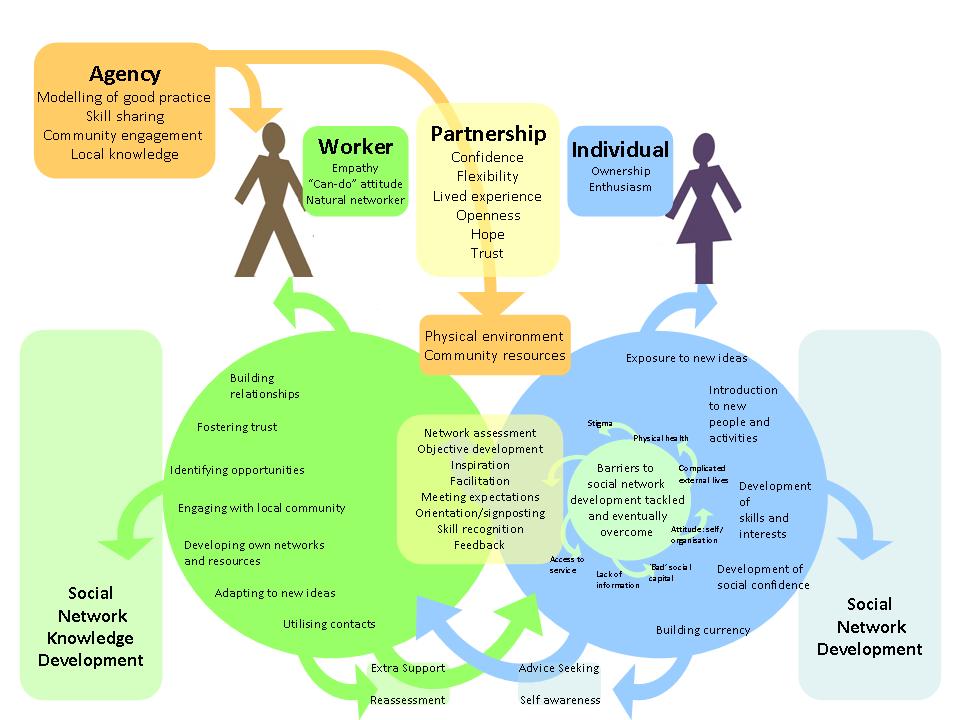
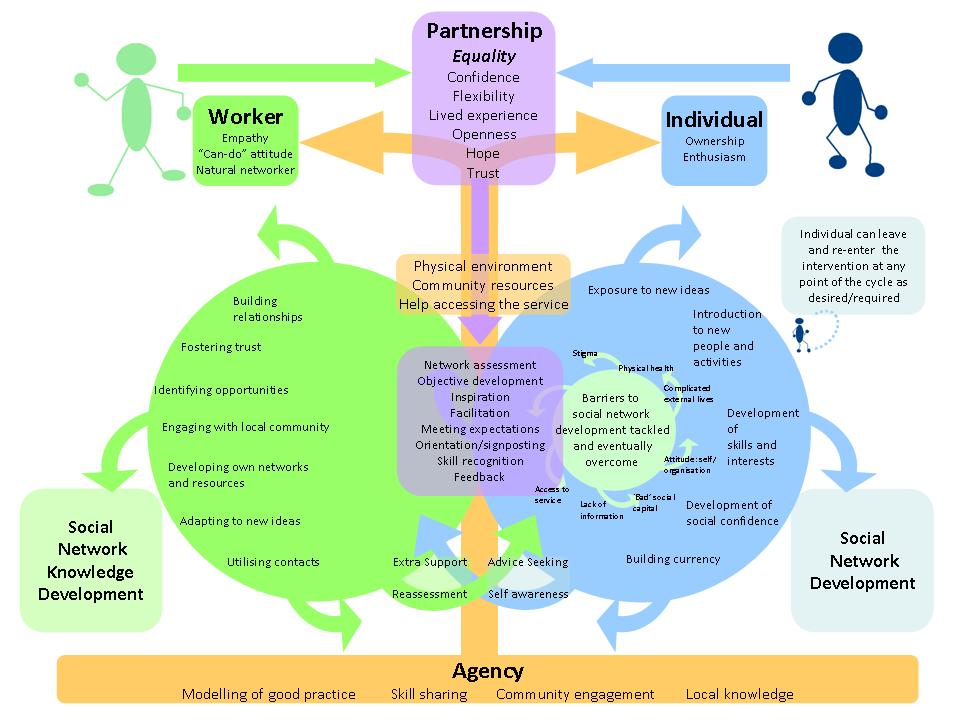
The Connecting People intervention model is based on co-production principles, that is, workers and the people they work with decide the objectives of their engagement together and work together to achieve them. It particularly focuses on social activities which provide opportunities for the development of social relationships. More information about the model (shown in static form below) can be found on a post on my website.


Funded by the NIHR School for Social Care Research, the Connecting People pilot study will evaluate the effectiveness of this approach in improving individuals’ well-being and social participation. The intervention model will be piloted in agencies which are able to readily adopt it from summer 2012 onwards.

We are currently searching for 12 agencies in England which would be willing to pilot the model and participate in its evaluation. This will require workers to undertake training of about 3 days (with supervisors undertaking an additional 2 days training to ensure the model becomes embedded in routine practice) and the agency adapting to the requirements of the model. Agencies will also need to support recruitment to the Connecting People pilot study to enable us to evaluate the process of its implementation and its effectiveness.

We wish to select teams for the pilot whose practice is already similar to the model as we appreciate it may take some quite a lot of time and resources to adapt to this way of working. To help us select agencies for inclusion in the study, we are inviting all those who are interested to complete a brief questionnaire about their work. The questionnaire is available here in a word document to download and complete. Please return this to me by email by Friday 16th March 2012 (my email address is given at the end of the questionnaire).

I look forward to hearing from you in due course, but if you have any queries in the meantime please do not hesitate to contact me.

Thank you!

The ClearFear Game: Using fun to tackle social anxiety

Connecting with other people is one of the ‘five ways to well-being’. Many people with mental health problems have small social networks and experience difficulties in making positive social connections. This is the main reason why we are exploring in the Connecting People study how health and social care workers can most effectively help people with mental health problems to connect with others.

One of our findings so far is that many people encounter difficulties in making the first step to connect with others because of a fear of social situations, or social anxiety. Of course, many people like me are shy or introverted. I am not ashamed to admit that I prefer solitary pursuits like blogging to parties, but at least I have a choice. If I would like to engage with other people in social situations, I can. I don’t fear being scrutinized by other people. I don’t worry for days about finding the right words to say to people. I don’t actively avoid social situations or suffer panic attacks when I’m in them. But many people do. Many people unreasonably expect others to be evaluating them negatively. Many avoid social situations or find them intolerably stressful. Many people suffer from social anxiety in various degrees of severity.

An American study found that 5% of the general population experience social anxiety disorder (at the severe end of the social anxiety spectrum) at some point in their lives. Although cognitive behavioural therapy can help, over 80% don’t receive any help. For many, it simply goes undetected. For others, the stigma of asking for help prevents them from doing so. However, we believe that it needs to be openly tackled to enable people to make social connections which can help them to get on with their lives. And we aim to do this using fun.

The Connecting People study team are teaming up with Kingston Recovery Initiative Social Enterprise (RISE) and Playmakers Industries to create the ClearFear Game. Last week, the RSA Catalyst fund – which provides small grants to RSA Fellows to develop innovative solutions to solve social problems – announced an award of £2,000 to help us to design and pilot the game.

The ClearFear Game will be a non-virtual game which will immerse people in social interactions which they would be otherwise fearful to engage in. Using the principle of ‘flow’ from positive psychology and gaming theory, the game will use fun as the active mechanism in relieving fearful situations.

The ClearFear Game will be developed by the Connecting People study team, members of Kingston RISE, Playmakers Industries, RSA Fellows and other experts during a ‘game camp’ on 6th-7th March in London. I’m not really sure what this involves, but judging by the YouTube videos, it looks like a lot of fun! We are actively involving people who experience, or have experienced, social anxiety during these two days to ensure that the game will be playable and fit for purpose.

Once it is designed, we will invite colleagues in Kingston RISE to pilot the ClearFear Game with people experiencing social anxiety to see if it helps at all. We will evaluate their progress before recommending it is used more widely. If the findings of the pilot are promising, we will aim to conduct further experimental evaluations of the outcomes of playing the game.

The development of the ClearFear Game and the results of the evaluation will be published online. The game itself will be made available using a Creative Commons licence. I’ll keep you updated on our progress on this blog and on the Connecting People study website. In the meantime, have fun!

Connecting the theory with the practice

Up to this point, our research has been focussed on gathering evidence from extensive fieldwork to form the base of our intervention.  We have travelled to projects all over the UK and consulted with a wide range of people engaging with different services including workers, volunteers, linked organisations, individuals accessing services, and funders.  This has aimed to ensure that the model is grounded in practical examples, and accurately reflects the processes that occur when a worker and a service user work together to increase the individual’s social capital.  Have a look  to understand in more detail the different components of the model.

Whilst we are still conducting fieldwork within several agencies, we are starting now to draw on our model to form the basis of a user-friendly, comprehensive guide of how to utilise the intervention.  We understand that whilst it is all well and good to have produced the model in the diagrammatical form you see in here, or if you prefer a more detailed explanation of the components on Martin Webber’s blog here, the professionals using it to guide their practice will need a more complete and practical set of materials to work from.

To do this, we are taking information from the fieldwork and using it to ‘flesh out’ the model – providing real-life examples at each of the stages.  For example, at the ‘building relationships’ stage on the worker side we will discuss points learned from interviews with service users as to what a worker can do to make them feel comfortable, including the importance of keeping to regular meeting times, remembering names and key facts.  We will also add suggestions that were given by workers at the projects we have studied on how to build rapport – for example sharing a small amount of information about themselves, or discovering shared interests to create an equal footing for the relationship to be based upon.

In order to supplement these practical ideas, we will also be producing a version of the model containing the procedures of a fictitious ‘gold standard’ organisation.  This takes the elements that different organisations from the study excel at and combines them to provide the ‘perfect’ example of how the intervention will work.  We hope that by combining the practical hints and tips, as well understanding how all of the processes fit together within this ‘gold standard’, professionals will be able to use the intervention to suit their own working style and the strengths and limitations of their organisation.

By continuing to conduct fieldwork as this process occurs, the model stays fresh and dynamic and ensures that the practical guidance that we offer from it does the same.

Once we have completed this process, we will be sending out a draft of the model and accompanying guidance to a wide range of individuals for their opinions.  If you are reading this post and feel that you would like to offer your perspective, please do get in touch with one of us at the study and we can talk about how you would like to contribute.

Next week, we will be visiting a project supported by Hestia in Kingston called Kingston RISE.  This service user led group is big on co-production with other organisations and should help us to discover more about how best organisations can link with external agencies to increase their members’ social capital.  For more information on Kingston RISE’s work, please have a look at this article.

Freezing but fun football fieldwork with Start Again

I spent last week in Birmingham visiting Start Again CIC – an organisation that provides a wide range of activities to engage young people from the local area and support them with decisions, changes and issues during an uncertain time in their life.

The original premise of Start Again used football as an engagement tool to encourage young people from the local community to participate, learning along the way lessons in teamwork and communication as well as about healthy lifestyles.  Start Again has since expanded into other sports (netball and yoga) and other activities (music) – as well as being due to open a semi-supported housing project in the next few months.  All of these streams aim to share the same ethos and atmosphere of openness and equality.

I spent the bulk of my time in Birmingham at the Powerleague pitches in Aston, where the football projects are run from.  I observed a variety of different groups of individuals accessing the Start Again scheme – from an open session where anyone could come along, to a closed session where clients from housing associations and the Early Intervention Service were participating.  I also observed a session of the Start Again/Development Keys ‘Winning Ways’ programme, consisting of 16-18 year olds from a local training centre. This again used football as the engagement tool, but taught more formal connections between behaviour and football inside the clubhouse, before the physical training began.  The ethos amongst all groups was the same, though, and it was a passion for playing the game.  As my predecessor David had reported last year, the footballers were effectively communicating and ‘playing fair’ throughout.  The impact of the Start Again value set was especially apparent during the Winning Ways session where lessons from the classroom were being played out clearly on the pitch.

As well as interviewing coaches, players and other staff at the Powerleague pitches, I also spent some time speaking to individuals with an external perspective of Start Again.  These included staff members from the EIS, supported housing agencies and the workers at the PCT.  These, combined with the internal perspectives of individuals who had been involved with the service for varying lengths of time, provided me with a rounded viewpoint on Start Again, how it has changed in the past year, and how it is continuing to change to fit in with future need.

I did not get the chance to attend any of the women’s only groups which is something that I am very keen to do in order to better assess the difference between programmes.  I will therefore be returning to Birmingham one Friday in February.  If anyone associated with Start Again would like to talk to me about their experience of the organisation, then please contact me on hannah.reidy@kcl.ac.uk and we can arrange a meeting.

In the meantime, the findings from this round of fieldwork from Start Again has allowed us to further refine the intervention model. This will ensure that it will fit with an organisation very different from BlueSCI in Manchester, by digging down to the essence of the process.

Thank you very much to everyone at Start Again for making me feel so welcome – and unobtrusive – last week.  I am aware that a female standing trying to remember the offside rule is not the most normal sight at the Powerleague pitches, but people carried on regardless! You allowed me to gain some really valuable insight into how Start Again’s processes work, and we look forward to sharing the results with you all soon.

Birmingham visit

Next week I will be going to visit the Start Again project based in Birmingham to complete the next round of fieldwork at this organisation.  Start Again uses sports as well as other activities to bring young people together in the Birmingham area.

As with BlueSCI, I will be hoping to catch up with interviewees from the last round of fieldwork to examine how they have moved through the organisation.  I will also spend time chatting to individuals who are associated with Start Again such as other linked organisations, referrers, and funding commissioners, to understand the project from a external perspective.

I will be getting involved with some of the activity sessions to gain an insider view of how the sessions work – apologies now for my netballing skills…!

More on the research at Start Again when I get up there, but here is a link to their website for further information on the organisation…

http://www.start-again.co.uk/

Funding confirmed for pilot of Connecting People Intervention

The pilot of the Connecting People Intervention will start in 2012, thanks to success with a bid to the third wave of NIHR School for Social Care Research funding.

The grant provides funding for a multi-site pilot to evaluate the effectiveness and cost-effectiveness of the Connecting People Intervention in comparison with other interventions aimed to promote well-being and social participation. We will be drawing on the expertise of our collaborators to ensure its success: Professor David Morris (Inclusion Institute, University of Central Lancashire),  Professor Paul McCrone (Centre for the Economics of Mental Health, IoP), Dr Martin Stevens (Social Care Workforce Research Unit, King’s College London), Peter Bates (National Development Team for Inclusion) and Polly Kaiser (Pennine Care NHS Foundation Trust).

About the pilot study

It is increasingly important for social care service users in England to develop social relationships and engage in their local communities as care provision diversifies. Social care workers have some skills in supporting people with this, but there is little evidence about which approaches are the most effective or best value for money. This study will provide evidence about ways of working which produce the best outcomes at the lowest cost.

The study will have four components:

1) We will begin with a systematic review of research conducted on this topic across the world to identify examples of effective social care practice. We will also look for examples of good social care practice in England in helping people to participate in their communities and enhance their individual well-being.

2) Building on the work of the Connecting People study with people experiencing psychosis, which is developing a new way for workers to help people with their social relationships (the ‘Connecting People Intervention’), we will develop equivalent guidance for workers supporting people with a learning disability or older adults with a mental health problem. We will consult experts, including users of social care services and their carers, about this guidance to help ensure it is fit for purpose.

3) We will develop a questionnaire to be used in our research that will measure the extent to which workers are following the intervention guidance.

4) We will invite six social care agencies across England to test the Connecting People Intervention and an additional six, identified in the first part of the project, to continue to use their existing ways of working. We will invite 240 people with mental health problems, a learning disability or older adults with a mental health problem receiving services from these agencies for the first time to take part in the study. Participants will be interviewed when they start receiving services, and again twelve months later. They will all be asked the same questions to help us to evaluate the extent to which the Connecting People Intervention is effective and represents good value for money in helping people to improve their social participation and well being.

We aim to ensure that the project will have a significant impact on social care in England by sharing findings about effective and cost-effective ways of improving social participation and well-being widely throughout the sector.

The full technical protocol for the pilot study can be downloaded here.

Updates about the pilot of the Connecting People intervention will be posted on the study blog.

The Updated Intervention Model! Comments Please!

Now the fieldwork at BlueSCI is complete, a model of the intervention upon which we will base all of our training material is ready for your comments.  This is still a work in progress and has the potential to change based on any findings in later fieldwork.

You can either click on the link here for the animated version The Updated Intervention Model (you will need powerpoint to view this), or have a look at the still image below.

We would really value any comments that you have about this model.  Is there something missing, or something that you feel doesn’t need to be included? Please place any comments below this post, or email them to us directly at hannah.reidy@kcl.ac.uk

Thanks, and we look forward to hearing your views!