International reach of the Connecting People Intervention

I am very fortunate to hold two roles with the Connecting People Intervention: one, as the full-time London based research worker on the pilot study, and two, as a part-time PhD student exploring the international scope of the intervention model.  To address the wide gap in global mental health implementation research and to promote capacity building of researchers in lower-and middle-income countries, I am working on expansion of the Connecting People Intervention to under-developed contexts that currently lack critical resources and skills.

Juggling two roles is not unfamiliar to me, for several years I have pursued my career in psychology research whilst also serving as a director for the small African development charity, SpanAfrica.   But until very recently these two passions for me—the drive to inform evidence-based research and to support meaningful change in underdeveloped countries—have not converged.  This is precisely the reason I jumped at the opportunity to explore the feasibility of taking the UK-based Connecting People Intervention to low- and middle-income countries (LAMICs).

I believe the Connecting People Intervention model has great potential to enhance health and wellbeing of vulnerable populations in LAMICs, especially with its focus on social participation.  I see the intervention as an opportunity to enhance social relationships between individuals whilst also developing the local community through existing services.  But most importantly the intervention model we have developed in the UK cannot simply be imposed on communities across the globe, instead my PhD will explore the ways that the CPI can be adapted to fit the local context.

With a background in health psychology and experience working in severely disadvantaged areas of Africa, I am often challenged by the varying approaches to addressing health inequalities through sustainable development.  We see blanket approaches where non-governmental organisations and international institutions will address seemingly similar issues exactly the same across vastly different countries or regions.

A story comes to mind of an NGO who visited a small rural town and asked male leaders what they needed most for their community. They responded, “a water well” because the women had to walk miles each day to access clean water.   The well was constructed but shortly after installation many people in the community fell ill and they determined it was the new well. What the male leaders didn’t understand was how important that daily walk was for the women.  It was their time for socialising, peace, and exercise.  One woman missed that time so much that she began contaminating the well water just to have that time back.  This is a story that reminds us the importance of truly addressing the needs of the entire community. Whilst the NGO had good intentions, and even worked with the local leaders, it wasn’t sustainable to the entire community.  Of course clean water is vital but perhaps the NGO could have consulted the entire community and in addition to providing clean water also considered opportunities for social participation.

Integral to conducting research in LAMICs is the need to establish strong relationships with key stakeholders to capture a realistic description of the challenges faced by vulnerable adults in the community.  Recently I have been collaborating with individuals from the King’s Centre for Global Health to explore the possibility of piloting the Connecting People Intervention in Sierra Leone.  The connections we are making now will enable us to reach individuals across health and social care systems in Sierra Leone to engage with community-based organisations, medical professionals, religious and community leaders, other mental health researchers, policy makers, and importantly, service users.  Connecting with these individuals in the research development stages, we seek to find the critical balance between addressing local needs in Sierra Leone with the innovative approaches that have been found effective in the UK.

We have developed a multinational research network that draws expertise and skills from diverse disciplines including social work and social policy, social and health psychology, medicine and nursing, global health policy and international development.  As a team we are scattered across the United Kingdom, Sierra Leone, and Australia with connections around the globe in these diverse fields of research and practice.

In order to assess the feasibility and acceptability of the CPI in Sierra Leone, we are arranging travel to Sierra Leone to engage with local stakeholders and gain a better understanding of the mental health services available as well as identify where significant gaps exist, forming the foundation for a needs assessment.  Drawing upon the extensive network of our international research team members in Sierra Leone we will use ethnographic methodology to gain a comprehensive description of the local context. This work will establish the potential for the model to benefit the outcomes for service users and inform the planning the protocol for a future pilot study.

The Connecting People Model in Action

The following case study is an example of the Connecting People Model in action within a Third Sector Service, working with individuals with learning disabilities, shown from the perspective of both the worker (Eric) and the individual (Jack).

Third Sector Service, Learning Disabilities

Eric:

When Jack first approached us, he wasn’t doing much and was outwardly angry and frustrated. He was bullied at school and had no friends and said it was because he was “different”. He had no self-esteem and was even alienating his family. We needed to put Jack at ease straight away because he was visibly upset about the state of his life, we thought  the best way to tackle Jack’s issues was to identify some opportunities for him to develop his own networks and then identify further resources. At first we tried to build a relationship by simply talking to Jack openly. We wanted to find out what he enjoyed doing and discovered that football was a passion for Jack. Someone I knew was already part of the local football team, so I utilised this contact and this person became a buddy for Jack and took him along to a football session. This proved to be a meaningful place for Jack to be and his confidence grew and grew, not only that but others started to see the assets in Jack. He has made friends and has discovered he is a good leader and teacher so has been looking into become a coach. This success has led to Jack seeking out more opportunities to become involved in the local community, and a new idea that Jack identified was going to a reading group. To begin with we weren’t sure what reading groups were available that Jack would be able to get to easily, so we contacted the library who knew of one that had just started a couple of months before. At first the leader of group seemed reluctant about Jack attending and seemed to have incorrect perceptions of what he would be like, however after talking with them and agreeing to go with Jack to the first session, the leader agreed and when they had spent some time with Jack, their attitude changed completely and they could see the great potential in Jack and were inspired by him. Attending this group enables Jack to be included in a totally different environment to the football club and we can see that it is turning out to be marvellous for his mental capacity and has led to all sorts of people realizing that he isn’t “different” at all!

Jack:

I was so annoyed when my family said they didn’t know how to be around me anymore, and I should “go see someone”. I thought they wanted to get rid of me so was really scared when I first went to meet Eric but when he explained that I could meet with him whenever I wanted to I felt much more relaxed. I felt I could speak with him really easily because he was so relaxed and friendly, that first meeting all we did was chat about what I liked doing! Looking back I just think how lucky I was to get the chance to meet him, and all the other people who worked there! I love my buddy! He helped me so much when I was feeling like I had nothing to live for. He found out that I like to play football every day and have found that I’m even good enough to teach other people. I took a football book to my book group and everyone loved it! I feel so excited to be sharing my love for football with lots of different people. It feels good to be able to know more about something than other people! I’m reading a book about a farm now which is totally new to me but I’m actually enjoying it, my friend from the reading group told me to read it, I’m glad I listened to her! My Dad says I have grown up a lot and I’ve started to feel a lot closer to my family lately. I love waking up in the morning and getting excited for what the day might bring.took a football book to my book group and everyone loved it! I feel so excited to be sharing my love for football with lots of different people. It feels good to be able to know more about something than other people! I’m reading a book about a farm now which is totally new to me but I’m actually enjoying it, my friend from the reading group told me to read it, I’m glad I listened to her! My Dad says I have grown up a lot and I’ve started to feel a lot closer to my family lately. I love waking up in the morning and getting excited for what the day might bring.

Engage with the Connecting People Study in 2013

2012 has been a very busy year for the Connecting People Study team. We completed the ethnographic research and developed the Connecting People Intervention (CPI) model via focus groups and a Delphi Consultation. We recruited 18 agencies to pilot the intervention and have undertaken training in 15 so far. We are now in the midst of recruiting the participants for the evaluation of this pilot and undertaking baseline interviews. This process will continue throughout 2013.

In addition to undertaking the study in 2013, we will be involved in a series of events throughout the year to introduce the Connecting People Intervention to a wider constituency of practitioners, managers, commissioners and users of health and social care services. Although we don’t yet have data on its effectiveness, we would like to engage potential stakeholders in discussions about its implementation to help refine the intervention and broaden its impact.  These will include workshops, seminars and conference papers. The first three have already been scheduled.

In early February I am hosting a visit from some researchers from Rosklide University in Denmark. Making Research Count at York have organised a half-day seminar to allow interested people to hear more about their research. I will be talking about the Connecting People study and David Morris will be talking about the Connected Communities project led by the Royal Society for the Arts. The seminar, Community in Focus: Social Work Making Connections, will be held at King’s Manor in York from 9.30 am to 2.00 pm on Friday 8th February 2013. It is free to Making Research Count members, mental health social workers and Approved Mental Health Professionals in the Yorkshire and Humberside regions. Otherwise, places cost £75 each. Please click here to see the flyer for additional information and booking details.

A week later, the Connecting People Study team are hosting a workshop for practitioners and managers interested in implementing the Connecting People Intervention in their agencies on Friday 15th February from 10.00am to 1.00pm at The Strand campus of King’s College London. The Connecting People Intervention Study Fast Track Workshop will feature a presentation about the intervention model and some interactive training exercises we use in the intervention training. As we are inviting all the participating agencies to attend, there will be an opportunity to discuss the on-going piloting of the intervention with people who are using it in their practice. We are also providing a networking lunch to encourage participants to informally discuss their practice in the context of the intervention model. More information about how to book onto this free workshop is available on this website.

Later that day, I will be presenting a paper on the study in a Royal Holloway University of London Department of Social Work Research Seminar. This is likely to have a more academic focus than the other events as it will explore the more technical aspects of the study, including the construction of the intervention model and the methodology of the pilot study. However, limited free places are available for the seminar which will be held from 4.00pm to 6.00pm at Bedford Square in London on Friday 15th February. Please click here for more information.

I will also be giving presentations at conferences in Finland, Los Angeles and London on the Connecting People Study during 2013, in addition to many other local workshops and seminars. If you would like me or one of the study team to talk at your event about the intervention or the study (or both), please do not hesitate to get in touch with us.

In the meantime, on behalf of the Connecting People Study team I would like to thank all those involved in the study and the piloting of the intervention for their hard work during 2012. We look forward to continuing our work with you in 2013.

Martin

The Connecting People Model in Action

The following case study is an example of the Connecting People Model in action within a CMHT, Older Adult Mental Health setting shown from the perspective of both the worker (Kay) and the individual (Deloris).

CMHT, Older Adult Mental Health

Kay:

When Deloris first came to the service she had recently lost her husband.  She was coping reasonably well but several months after the loss her sadness had not improved and seemed to be getting worse.  At the time that I met Deloris she was clinically depressed but seeking change in her life.  Deloris has two daughters who live in London and Birmingham with their families.  They visit on occasion and have expressed concern over Deloris’ situation but are unfortunately unable to be involved on a daily or weekly basis.

Through our initial assessment and building a relationship of trust, I could tell that her depression stemmed very much from her loneliness and isolation.  At aged 72 and living in a rural area, her husband and the couple friends they had together were her main source of social contact for many years.  Although mobility was not an issue, she has deteriorating sight and is therefore unable to drive. When Hugh passed she found it difficult to leave the house and connect with others.

Because she was motivated to recover from the depression we initially worked on exploring her interests (past and present) and setting achievable goals for getting out of the house and connecting with others.

Many of the other service users I work with have mobility issues, making it increasingly difficult to leave home and get connected to others.  Aside from her inability to drive, she is still able to get out of the house.  She can walk to the local shop but the buses to larger towns only run once per day.  We had initial discussions of practical support because she needed to get to the GP regularly for vision exams.

Together we decided to look for activities in the area that Deloris could get to on the bus, and set goals initially to leave the house twice per week.  I was able to take her to some activities but wanted to be sure these were opportunities to meet new people so that she could continue getting involved without me.

Deloris:

From the beginning I really enjoyed my time with Kay.  She came round to see me every week or so and we’d have a cuppa and start chatting.  I never felt like she was just testing me, or asking too many questions.  You know how some support workers are, they seem to be ticking boxes rather than getting to know a person.  I never felt that way with Kay.  She was friendly and never pretended to have lived through my experience.  She let me share details about my life and I felt that she understood, without necessarily having lived it herself.

We started talking about my hobbies and interests and sometimes I don’t feel like I have many at all.  But she helped me to think back about what Hugh and I used to do together.  He was a farmer and was quite involved with the union of farmers in the county.  When they met together, I would go and see the wives, but hadn’t been since he passed away.  I wasn’t so sure that I could go back to this group without Hugh. Kay suggested we go together. Her brother is also a farmer in the area and we decided to go to the meeting together for a few times so that she could introduce me to a few people.

Well the first time I was really nervous. I hadn’t been out to see people much recently and I didn’t know how others would react to my being there.  Also, I worried that people wouldn’t be the right age.  Sometimes I feel that I have nothing in common with people from the younger generation but those in my age group have many more health problems than I do.  It’s all they talk about sometimes!  But at the first meeting I recognised a few people and was happy to have Kay there with me.  It took a few meetings before I felt ready to go on my own but I’ve met one woman who lost her husband too and we’re now able to go to the meetings together. Next week we’re planning to go to the travelling cinema that comes to the area once per week.

I’m still seeing Kay regularly but with meeting new people I feel less anxious about leaving the house.

“Pracademics” on blogging as a research dissemination strategy

Check out this post from Dr Martin Webber, written by Laura Clohessy, for London School of Economics, on the scope for blogging within academic research and practice.

Just this morning I received an email from a colleague with new impact factor figures for popular journals, and yet we ask ourselves, are academic journals the most impactful way to reach individuals who will implement the findings of research?  The LSE article discusses the impact of blogging and how it serves as a platform to document the progress of a study.

We’re curious, what do you think about blogging as a strategy to disseminate research?

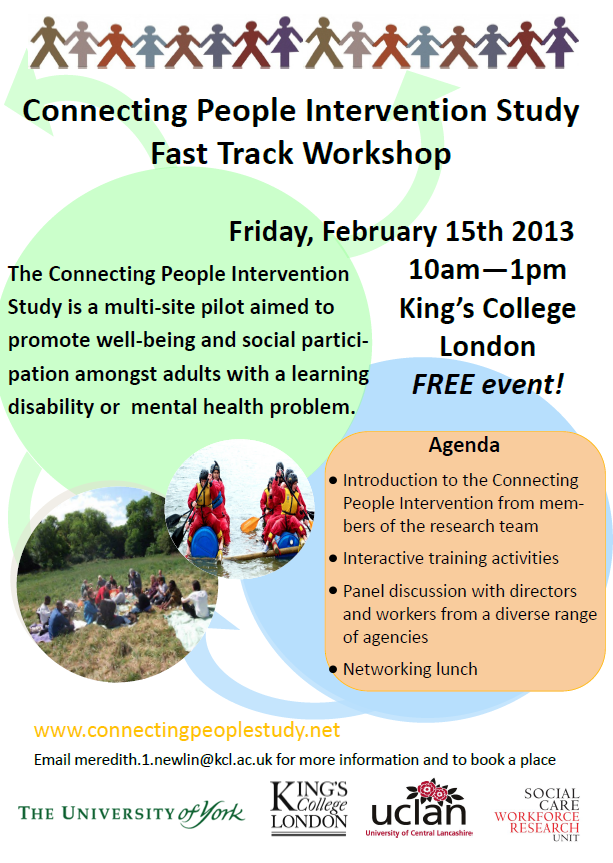
Fast Track Workshop – 15th February 2013

Image

On Friday, February 15th 2013 (10am – 1pm) the Connecting People Team will be hosting a Fast Track Workshop at King’s College London. The event will act as an introduction to the Connecting People Intervention. There will be interactive training activities to engage in and a panel discussion with directors and workers from a range of agencies.

The event is free and will include a networking lunch.

Please see the event invitation here.  If you are interested in attending or would like more information please contact Meredith Newlin at  meredith.1.newlin@kcl.ac.uk.

Fast Track Workshop

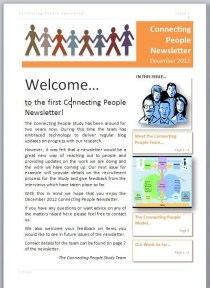
Issue 1 – Connecting People Newsletter

An early Christmas present from the Connecting People Team to you…

Here is Issue 1 of the Connecting People Newsletter. This another way in which the Connecting People team will keep people updated on the work we are doing. It is hoped that this will help the team reach out to even more people and promote further interest in our work.

NewsletterPlease let us know what you think of the newsletter. Issue 2 will be produced in Spring 2013. If you have ideas for things you want to see in this get in touch.

The Connecting People Model in Action

The following case study is an example of the Connecting People Model in action within a Mental Health setting shown from the perspective of both the worker (Vish) and the individual (Greg).

Assessment team, mental health

Vish:

“When I first met Greg he was very nervous as he perceived our service to be the ‘judges’ of whether or not he could keep his Personal Budget.  It was important to make him feel at ease straight away by being friendly, having a bit of banter with him about the football (I’m a United fan and they’d just won against City), and above all being very open about the process.  I could tell he was a man who got confused by the paperwork (don’t we all!) so whereas with some clients I go through the forms bit by bit, with Greg we just spoke and I filled things in after our session.

I get a lot of clients through the door as the nature of our service means we see a lot of people once every few months, so I always keep a record for myself of what we spoke about, reflections on how the sessions go and such so that I can remind myself of it when our next meeting is due (with Greg it had made a note to check the football results before I saw him again). 

Our service is obviously trying to cut costs but we all try and look at this in a positive way – so the reason that someone’s Personal Budget is reduced is because they are more integrated with community activities and services that don’t require funding.  To make this work I have to have really strong knowledge of all of the available services out there – and constantly be looking for new ideas of where someone could go, where they could try out.  Here at our base we have a big table full of leaflets, fliers, and all sorts of information about different schemes in the area, which helps with inspiration if you are a bit stuck. 

With Greg it was relatively easy as he was keen to become more active so a gym referral was the obvious choice.  Then beyond that I remembered a local running club that I had heard good things about so after chatting with them about being supportive of Greg, put him in touch with them too.  Because I don’t see him very often we try and set clear goals each time that he can then manage with the help of other people. This last session, we decided that he should go for a commitment goal as Greg has had problems attending something regularly due to his depression.  We spoke with the gym and Greg decided to attend a regular kick-boxing class there, committing to attend every week.  Greg also wanted a tangible target, so I investigated and with the help of the running club found a 5km run that Greg is going to enter in three months time. 

Greg has good insight into his condition and knows that exercise and keeping busy helps stop his low mood, whereas sitting in the resource centre that he had been a member of full time does not help.  It is all about having these solid goals to keep him moving forwards in the direction that he wants to go.”

Greg:

“I was really not looking forward to meeting Vish because I had heard from friends in the mental health system that as soon as you stop getting a full time care coordinator, your support and your benefits start to stop too.  Vish was nice though, he had some similar interests to me and I didn’t feel as scared about what this meeting meant after a few minutes in the room with him.  He was really reassuring about it all and didn’t sit behind a desk with loads of official documents and stuff, it just felt like we were having a chat about what I liked to do and what I wanted to be doing in the future.  He reassured me that I wouldn’t have my Personal Budget stopped as long as I needed it, and that if it did happen it would be because I was doing other things that didn’t require one any more.  I had never thought of it that way before.

It was weird because even though I sort of knew that I wanted to do more exercise, Vish helped me work out what exactly I could be doing and put it into small bites of tasks.  I had been sitting in a mental health resource centre not really doing much up until recently when my Personal Budget was up for review, and I think that had maybe made things worse.  I had been quite worried about just going to the gym as I feel pretty unhealthy compared to how I used to be before I got ill, so when Vish told me that he knew the people at the gym, that he had referred other people over there before me, and that the staff there were really supportive I felt a lot better. 

He also told me about the local running club and put me in touch with them.  I’ve been going once a week to that since our session, and feeling a lot fitter.  Its really nice to go somewhere where the point of the activity is just to run – its not some medical thing where everyone talks about their illness and stuff.

After we spoke about the running club, we decided ‘no time like the present’ so spent the remainder of the time visiting the local gym and getting the induction form filled in.  I know that Vish only has a bit of time with me so it felt good that he could come and do that.  I am not seeing him again until our next session which is a few months, but the goals that we have set are keeping me busy – I have a 5km run quite soon which I am trying to get a PB in! He wants to know how I do in it so I will email him after it.

All in all, Vish has provided me with all the support he can, and has linked me in with people that can help me get back on track and that have the time to spend with me, and all doing activities that I am actually interested in.”

Connecting practice with policy

We have now trained fourteen agencies across England in the Connecting People Intervention (CPI) model. We use the term ‘training’ loosely, because much of what we have been doing is facilitating a collaborative learning process. This has been especially insightful for members our research team, who have sought to make each training day bespoke to the agency based on strengths and needs of the workers. We don’t see traditional roles of ‘trainee’ and ‘trainer’!

As you know from this previous post, the health and social care agencies involved in the study are very diverse, yet many face similar challenges to their ways of working with people receiving services. From our discussions with social workers, community psychiatric nurses, occupational therapists, community development workers and support time and recovery workers, we are gaining a better understanding of how the CPI model fits into existing practice. The feedback thus far has been positive, with most workers affirming that the model largely describes the work they are currently doing.

We are also learning from practitioners how recent changes in policy impact on their work and the implementation of the CPI model. For example, community mental health teams are under pressure to discharge people back to primary care much earlier than previously. While consonant with the principles of autonomy, independence and social inclusion, this reduces the time which practitioners have to engage with people and help develop their circles of support prior to discharge. Sometimes social workers are able to do little more than sign-posting to other resources before moving people on and out of ‘the system’.

NHS targets such as CQUIN and payment by results are shaping practice in mental health services. Additionally, the move towards personal budgets and self-directed support in social care are shaping social work practice. Both can squeeze out working with local communities and communities of interest to implement the CPI model. However, agencies participating in the CPI study are finding creative ways to incorporate the model into their practice. In Derby, for example, social workers are using the model to define their practice and articulate their distinctive role in working with people with mental health problems.

Last week I spoke to a conference of mental health social workers in London about their untapped potential (my presentation can be downloaded here). I argued that an over-reliance on statutory functions to define mental health social work leaves the profession vulnerable to the whims of policy makers. There was an overwhelming consensus from practitioners that bureaucracy needs to be reduced and more time freed up to work with people to implement ways of working as described in the CPI model. Senior social work leaders involved in the CPI study are working hard to free up time for practitioners to work in this way, but there is a long way to go in re-defining mental health social work as the locus of social intervention in mental health services.

In terms of the CPI study, these changes are relevant to our recruitment of new referrals to the study and the way that practitioners are engaging with those individuals.  For example, in agencies where the social work role is to primarily assess individuals, the intervention is defined as building a relationship and then engaging collaboratively to identify their strengths, needs, and interests, then signpost them to other services.  From our perspective this equal partnership developed between the worker and individual is still adhering to the CPI model and therefore such individuals would be eligible for participation in the CPI study.

As we aim to recruit up to 240 individuals in the coming months we look forward to capturing how policy impacts on practitioners and service users, and on the implementation of the CPI model. We welcome your feedback on how policy impacts on your practice within the CPI model or your experience of it. Please feel free to leave comments below.